
Media Composer Training
From harmony and arrangement to a finished cue: composing for film, games and advertising, produced with MIDI and real recordings.
What this course is
Composing for media is a different job from writing music for its own sake. There is a scene, a brief, a deadline and someone else’s intention to serve — and the music has to be good anyway. This course teaches both halves: the craft of writing and arranging, and the production skill to deliver it.
From sketch to delivery
You will work through harmony, form and arrangement, then move into production: MIDI programming, recording real material, and mixing your own cues. The applied blocks — film, game and advertising music — each come with a project, because the differences between them only become clear when you have to solve them.
The business material is deliberately included. Knowing how rights work and how to discuss a fee is part of being able to do this professionally.
Who this course is for
- You write music and want to work to picture, brief and deadline.
- You play or arrange, but want to produce your own work to a releasable standard.
- You want to understand the industry side as well as the creative side.
- You are ready to build a portfolio rather than collect certificates.
What you will be able to do
- Write and arrange music that serves a scene, a game state or a brief.
- Produce a cue from sketch to mix using MIDI instruments and recorded material.
- Work with a picture edit and deliver stems in the expected format.
- Design sound as well as write notes, and know when each is the right answer.
- Present a portfolio that shows range rather than one style.
Curriculum
Musical foundations
- Music theory and rhythm
- Harmony and form
- Arrangement from classical to popular styles
Studio technology
- Studio technique and signal flow
- Microphone technique for composers
- Working with recorded and virtual instruments
Production techniques
- MIDI production and programming
- Recording your own material
- Mixing your own cues
Creative sound production
- Sound design
- Sound installation
- Remix and reinterpretation
Applied music
- Film music
- Game music
- Advertising music
Working as a composer
- Building your own portfolio
- Communication and negotiation
- Business models in the music industry
- Basics of business management
What the practical weekends cover
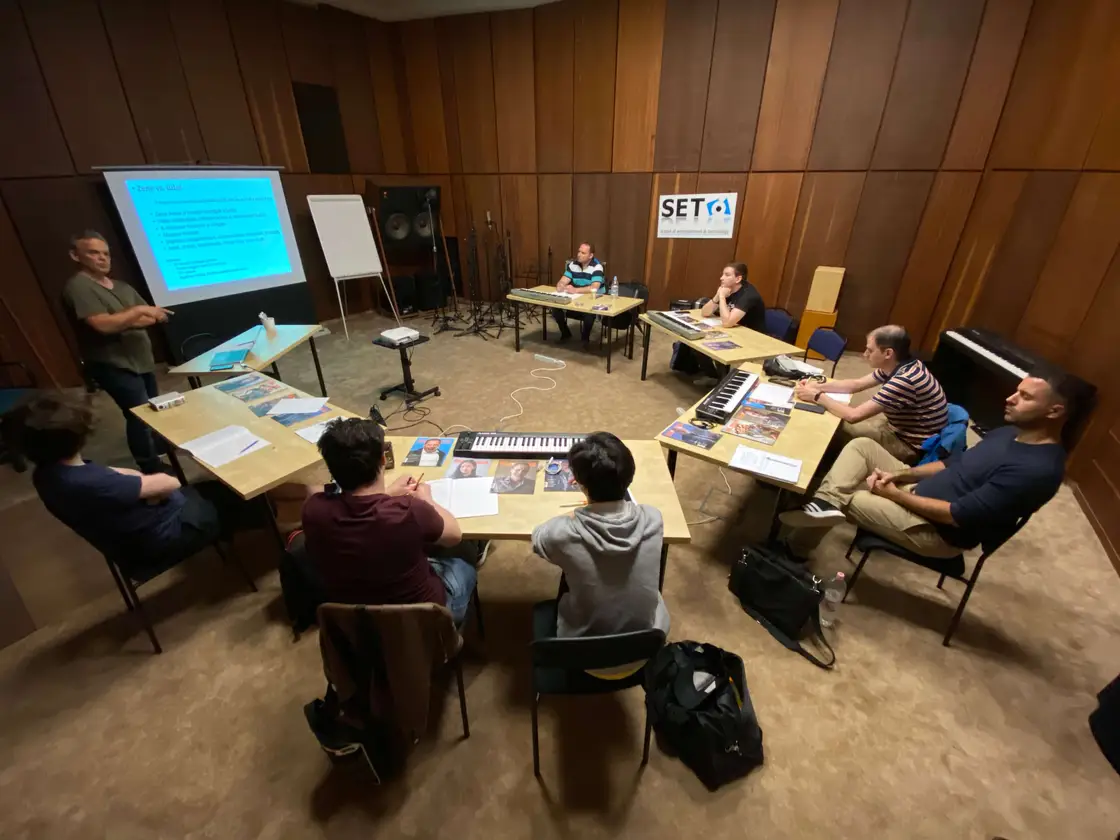
Weekends run from Friday to Sunday and focus on the parts of composing that need a room and other people: recording your own material, working with performers, and hearing your arrangement on reference monitoring.
- Two exercises each month on the platform
- One or two webinars a month on the current topic
- Four project assignments across the course
How the learning works
Learning platform
Structured material, exercises and a forum, available around the clock.
Production tools
We provide the Pro Tools access needed for study. If you already work in another DAW, you can keep using it for composition work.
Project-based progress
Progress is measured in finished pieces: each project adds something you can show.
Feedback from working composers
Your submitted work is reviewed and discussed, not simply graded.
Entry requirements
Equipment and software
- Computer with an internet connection
- Audio interface
- Headphones
- MIDI keyboard (provided during the practical phases)
Equipment and software
- A DAW of your choice (Pro Tools, Cubase, Logic and similar are all suitable)
- Pro Tools access is provided for the duration of the course
Benefits
- 01
You finish with work, not just notes
Project assignments are built so that each one is portfolio material.
- 02
Three applied fields
Film, game and advertising music each ask for different thinking. You practise all three.
- 03
Technically self-sufficient
You learn enough studio technique to record and mix your own material without waiting for someone else.
- 04
Industry basics
Rights, business models and negotiation are part of the course, not an afterthought.
Frequently asked questions
What does semi-virtual mean?
/ Learning concept
You get your own access to an online learning platform with teaching videos, written material, exercises and a forum, available around the clock. Your physical presence is needed only for the practical phases: three-day weekends spent working in a studio environment. Everything else can be done from home, flexibly.
What equipment will I need?
/ Equipment
For the sound engineer training: a computer, an audio interface, headphones and a microphone for home exercises. For media composition, additionally a MIDI keyboard, which is provided during the practical phases. For media photography, a camera with fully manual controls. We provide the Pro Tools access needed for study during the course.
Can I complete the course while working?
/ Working while studying
Yes — the concept was designed for it. The online phase has no fixed timetable, so you move through the material when you have time. The practical weekends are the only fixed points you have to set time aside for, and we announce them in advance. It does take steady work, though: anyone who only prepares for the weekends falls behind.
How to apply
From harmony and arrangement to a finished cue: composing for film, games and advertising, produced with MIDI and real recordings.